ROAD TEST:

Abarth Grande Punto review

by David Finlay (4 August 2008)

Engine
1368 cc, 4 cylinders
Power
155 bhp @5500 rpm
Torque
145 ib/ft @3000 rpm
Transmission
6 speed manual
Fuel/CO2
40.9 mpg / 162 g/km
Acceleration
0-62mph: 8.2sec
Top speed
129 mph
Price
From £14050.00 approx
Release date
01/07/2008
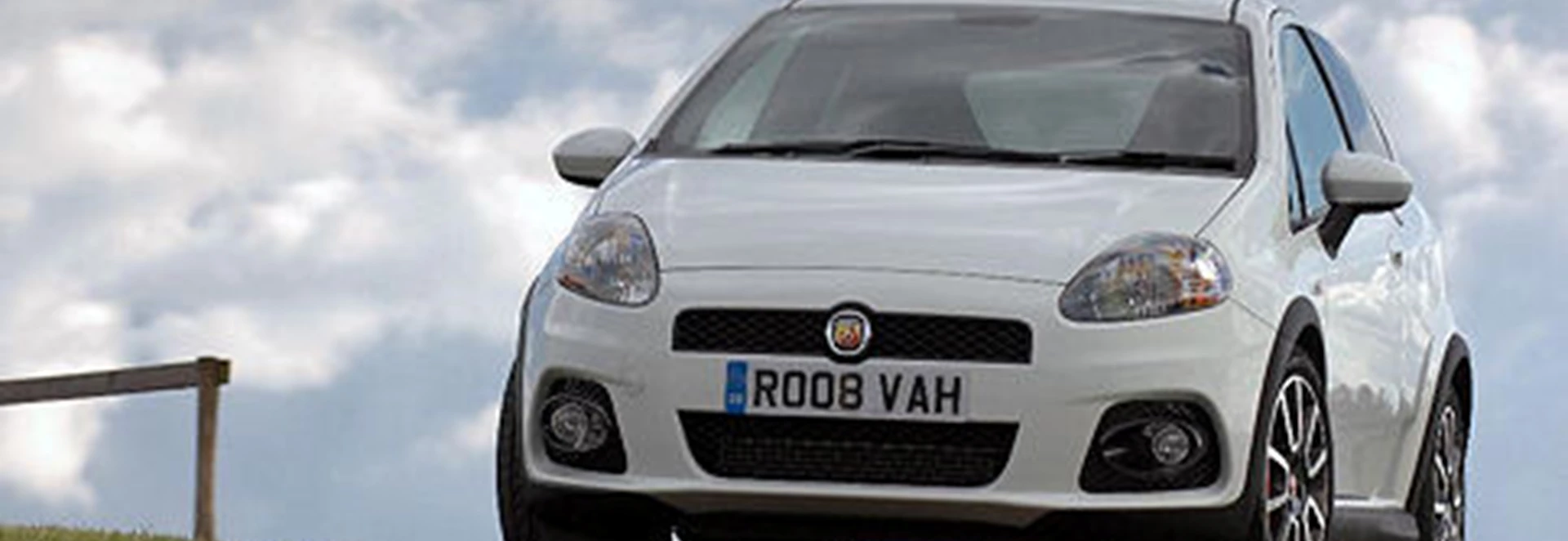

It would officially be quite wrong to describe this car as a Fiat. It's Fiat-based, of course, and the company at the head of the scheme is Fiat Group Automobiles, but what you see here is the first Abarth-branded car to be introduced to the UK (in the 21st century, at least), and the name of the celebrated Italian tuner is being promoted almost to the complete exclusion of that of the manufacturer. So, no more Fiat references.

Abarth Grande Punto. In standard form - we'll come to the non-standard forms shortly - the Grande Punto Abarth is the most powerful car in the range, knocking the 130bhp turbo diesel off its pedestal. The power comes from a version of the 1.4-litre T-Jet turbo petrol engine, tuned in this case to provide a maximum of 155bhp, which is enough to push the car from 0-62mph in just over eight seconds and on to its ultimate of 129mph.

This puts the Grande Punto Abarth into warm hatch territory, and it has the brakes and suspension to match. Compared with the standard car, the Abarth has stiffer front springs and a thicker front anti-roll bar, it rides 10mm lower, and it makes contact with the tarmac through 215/45 tyres on 17" alloy wheels.

This isn't an especially sporty set-up, though you'd think it was from the way the tyres transmit every last bump into the cabin when you're pootling through town; not only could you tell which way up a 5p piece was by driving over it, you could identify who dropped it from their fingerprint.

Once you get out into the country and start driving with a dash of enthusiasm, though, the Abarth becomes a lot smoother. In fact, if anything it feels pretty soft, though the suspension is well controlled, and the car will charge over rough stuff that would either fling many other hot hatches towards the scenery or leave them floundering in a fog of traction control.

Abarth Grande Punto. The gearchange is quite floppy - the lever can be moved sideways by at least an inch when the car is in gear, and for me it's mounted slightly too far back, with the result that I missed a few quick shifts from second to third. But the actual engagement of cogs is smooth and positive, so overall the driving experience isn't harmed too much.

And it is quite an experience. At speeds which are just this side of respectability for the public road, the Abarth feels quite precise, it has a lot of grip, and the engine - which shows virtually no hint whatever of turbo lag - is a delight. For £13,500, this is a very appealing performance car.

But you can spend quite a bit more than that. There are various optional extras - leather upholstery, a different wheel design, metallic paint, an electric sunroof and so on - which can easily be combined to add a couple of thousand quid to the bill, but the big news concerns the special kits which can be added to spice up your Abarth's handling and performance.

Abarth Grande Punto Interior. There are two, and they're called Assetto and esseesse. Assetto consists of uprated front brakes, lower-profile tyres on 18" alloys and a revised suspension which brings the ride height down by a further 20mm all round. The esseesse kit is all about power - it boost the maximum output to 180bhp and also makes sure that the engine will still run at acceptable temperatures despite all the extra energy.

Both kits have to be dealer-fitted (within one year or 12,000 miles of the car being registered) and you can't have the power before the brakes and suspension have been uprated, which is very sensible. The combined price of the two kits is £3500, bringing the cost of a Grande Punto Abarth esseesse to £17,000 without optional extras.

One thing about the kits which seems utterly daft is that once they've been fitted you end up with a pile of standard Abarth parts which you have paid for but can no longer use. I haven't heard a sensible way of dealing with this: you could try to sell them privately, in the unlikely event that there's a market for secondhand Abarth Grande Punto bits; or you could see if the dealer would buy them back (good luck with that one); or perhaps you could paint them in jolly colours and use them as ornaments round the house. Whatever you end up doing with them, the whole thing strikes me as a very clumsy arrangement.

Abarth Grande Punto, Harewood Hillclimb. Anyway, how effective are the kits? Well, I've driven an Abarth essesse, but not on the road, which is why this test is nominally about the standard car. But I've also driven both versions up the Harewood hillclimb course in Yorkshire so I can at least make a comparison.

As a motorsport venue, Harewood is seriously odd, and not just because it includes a steep plunge downhill (hillclimbs are, as the name suggests, meant to go the other way). There are some sequences where one corner bears no relation to the one immediately before it, most notoriously at the top, where you're blasting round a blind righthander (all but flat-out in an Abarth) and suddenly the road disappears over your right shoulder round an excruciatingly tight hairpin. It's all rather peculiar in a pleasant sort of way, and it makes Harewood a challenging venue for car and driver.

It certainly gave the standard Abarth something to think about. The balance that had made this car so impressive on public roads fell apart at Harewood, and most of the secret to a quick run involved making sure that the understeer didn't become terminal.

Abarth Grande Punto.The car with the esseesse kit was much better: the extra power made a big difference, and the superior handling meant that you could (and indeed had to) take the ugliness out of your driving and replace it with finesse.

For motorsport-related driving, the esseesse is clearly much better, but it does cost £17,000, and there's nothing you can do to a Grande Punto to make it feel like it's worth £17,000. And although I haven't actually experienced this, I suspect that the Assetto suspension mods will make the car far less comfortable on the road. So the conclusion seems clear: if you want a fun car for trackday use and you have a reasonable budget, go for the esseesse bits, but if you want a more satisfying road car, stick with the basic package.


Add new comment

Plain text

To prevent automated spam submissions leave this field empty.

Model Search

Manufacturer Search

back to top