ROAD TEST:

BMW M3 CSL review

by David Finlay (27 February 2004)

Engine
3246cc, 6cylinders
Power
360bhp @7900rpm
Torque
273ib/ft @4900rpm
Transmission
6 speed semi-auto
Fuel/CO2
23.7mpg / 287g/km
Acceleration
0-62mph: 4.9sec
Top speed
155mph
Price
From £57801.00 approx
Release date
01/07/2003
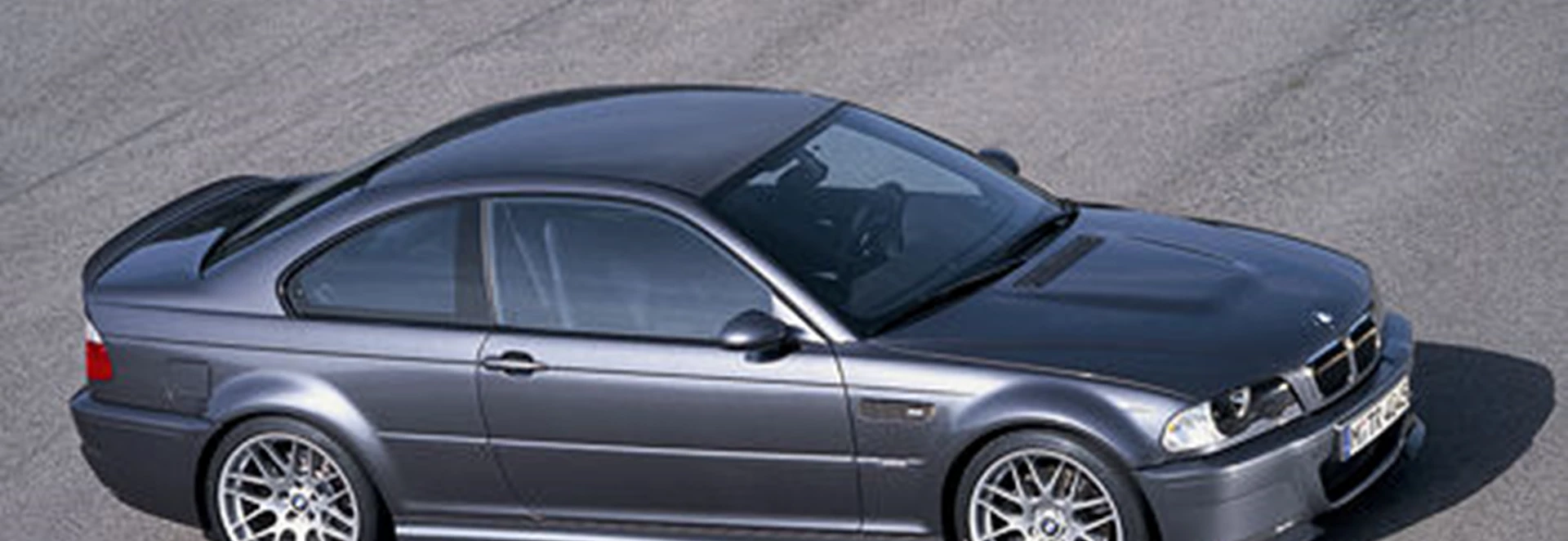

If you were to ask me from a standing start which car of the present era had enjoyed the shortest production run (major manufacturers only), I would probably say that the Renault Avantime had achieved this record with the absolute minimum of effort. At this point you would be thoroughly justified in calling me an uninformed old juggins and reminding me of the existence of the BMW M3 CSL.

CSL is an old conglomeration of letters which means about the same to BMW as RS does to Ford, WRX does to Subaru, Evo does to Mitsubishi, four-wheeler does to Reliant, and so on. When raised, the CSL flag means "Important! Special model at large. Expect to pay a lot of money in return for thrilling performance."

This particular CSL has only recently come on the market, and it's about to fall straight back off again. Production has already stopped, though at the time of writing you can still buy a new one through BMW's UK dealer network.

It's not a car which could have lasted for long in any case, being frighteningly expensive and not the sort of thing most people would be happy to use every day. None of which alters the fact that it is a remarkable piece of kit.

BMW M3 CSL.For your £58,455 . . . shall I pause to let you get up off the floor? . . . for that considerable expenditure you get an M3 derivative which looks particularly butch on the outside but in many ways rather disappointing on the inside. The steering wheel (lovely) and seats (incredibly supportive) tell a few tales, as does the petite silver gearknob, and the fact that the numbers on the revcounter read as far north as 9000rpm creates a little thrill of anticipation. Apart from these and one or two other trinkets, the interior of the CSL seems not so much sparse as low-spec.

And that's pretty much the way things are. The CSL does not have much in the way of equipment, for the simple reason that anything which provides passenger comfort also brings with it weight which blunts the performance of the car. Partly because of all this asset-stripping, the one thing you can't say about the performance of the CSL is that it is blunt.

Weight reduction is nothing like the full story, of course. The 3.2-litre engine has been tweaked and attended to and refashioned and generally given a kick up the backside so that in this application it produces 360bhp, giving a power-per-litre figure almost exactly the same as that of the Ferrari 360 Modena.

Neither of these cars uses forced induction, relying instead on their engines' ability to inhale, process and expel air by their internal workings. At this level of performance, naturally aspirated engines can hardly be prevented from sounding magnificent, and indeed the six-cylinder howl of the CSL is little short of spine-tingling.

(The argument shouldn't be taken too far, but it might be worth noting here that the BMW officially accelerates from rest to 62mph only 0.4s slower than the Ferrari does, uses far less fuel and produces far less CO2, and costs only slightly more than half as much. I mention this simply because it allows me to suggest that the CSL is in some way good value for money. It's the last chance I'm going to get.)

So. The CSL is powerful and sounds great. Since we're both grown-ups, you and I, we know, do we not, that power isn't everything when it comes to performance cars. The package requires a suitable transmission, intelligently set-up suspension and stonking great brakes to make it complete.

The CSL's brakes are easily explained. They are enormous and, from my road-only experience of them (I did pop in to a race circuit during this test with a hopeful expression on my face, but they'd closed for the day), entirely up to the job.

The transmission is another matter entirely. This is the sequential manual gearbox (SMG) job which BMW first introduced to the M3 several years ago, at which time I spent a merry afternoon horsing round Oulton Park and trying to remember which way you flicked the lever to make it change up ("forwards" is the answer, supplied that day by the son of nightclub owner Peter Stringfellow).

As far as the gearbox part of an SMG system is concerned, it is a plain ordinary manual - admittedly one with six closely-stacked ratios. The clever bit is that all the driver has to do is prod the lever in the appropriate manner to make the changes happen. Throughout CARkeys you will find innumerable references to the mess manufacturers make of systems like this (fie on you Alfa Romeo, Maserati, Mercedes-Benz and smart), but BMW has done it properly. The changes are smooth and quick.

In the case of the CSL, the smoothness and quickness are subject to variation: a small switch just behind the gearknob allows you to specify the rate of change. At the top setting the change is very rapid indeed, which is great if you're on full throttle but tiresome if you're just snicking down through the gears as you approach a T-junction.

For most road purposes I'd be happy with the most relaxed setting, though I would lose no time in zipping up to the opposite end of the scale at the first suggestion of a trackday. On such a day, I suspect I would feel that the CSL was as close to being a racing saloon as the requirements of real-world practicality could allow. It certainly seems that way on the road. Even at low speeds there can be no doubt about the car's true purpose.

BMW M3 CSL.But the inevitable compromises have been thoughtfully attended to. Considering the handling capabilities, the CSL has better ride quality than you might expect. Super-low-profile tyres and the need to keep body movement in check mean that you feel every last bump and ripple in the tarmac, but there is also a background feeling of softness, keeping the ride at least partly sensible and also allowing for a considerable amount of grip.

There is certainly grip in abundance. Even when disporting merrily over country roads, the only times I ever set the traction control system going were when I used a lot of throttle while one of the driven wheels was rolling over a patch of mud. On all other occasions, the CSL simply got on with what it was being asked to do. It behaved serenely in circumstances which were far from serene.

I've read criticisms about the CSL's steering, which is frowned on for lacking feel. Well, yes, it does lack feel - you can't sense what is going on by reading the messages passed on by your fingers. But the steering is also friendly (as long as you don't try to force it, which I imagine some testers may have done), and in any case the most effective source of information is the seat of your pants. Through the behaviour of its suspension, the CSL tells you exactly what is going on at both ends, to an extent that most other high-performance saloons cannot.

You'll infer from all the above that I enjoyed the CSL. Too right. I loved it. For about fifteen minutes. I'm glad I drove it, but there was not even the merest sniffle when I handed it back. I don't want to live with a car like this on a daily basis. If I had one, I could only realistically expect to use it as a toy, either at trackdays or on very quiet roads in very remote areas.

In a world in which people are prepared to pay upwards of half a million pounds for cars which can - but most likely never will - exceed 200mph, the value implications of the CSL are probably a trifling matter. All the same, this is a very difficult car to justify. It costs way too much, and although it does certain things brilliantly it can't be given a chance to prove this unless you take it on to a circuit.

This applies to several other cars, of course, but a similarly-priced Porsche, for example, has a special aura about it which allows it to attract huge amounts of attention even when it is standing still. The CSL not have the same kudos, being after all a derivative (undoubtedly a very special derivative) of the BMW 3-Series, one of the top ten most common model ranges in the UK.

All of which brings us back to that tiny production run. The CSL is quite a car in many respects, but it may be that the very best thing about owning one will be the fact that hardly anybody else does.

Add new comment

Plain text

To prevent automated spam submissions leave this field empty.

Model Search

Manufacturer Search

back to top