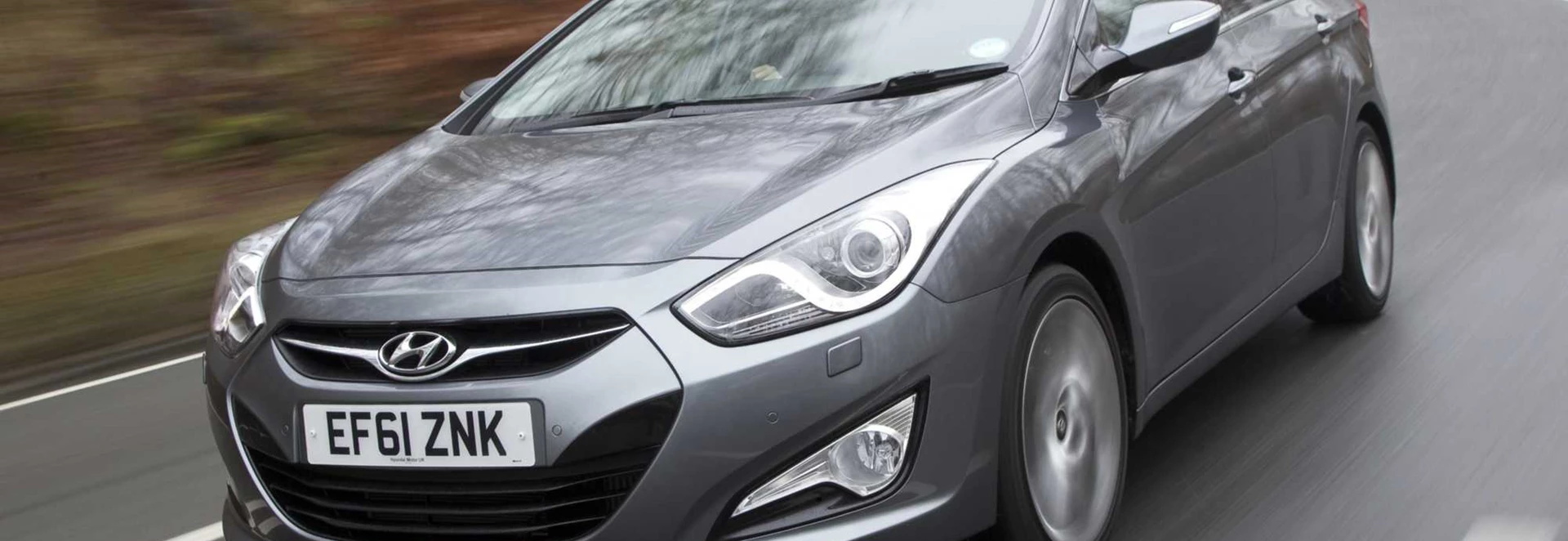
In a slightly unusual move, Hyundai first made its i40 available in the UK as a Tourer estate, but as you can see the saloon version soon followed. We think the attractive design of the i40 gives the Ford Mondeo and Vauxhall Insignia a run for their money, and fairs well against the Kia Optima, a very similar vehicle from Hyundai's sister company.
If you want an alternative to the European contenders, the i40 is a safe bet. It’s comfortable, well-equipped and has a range of economical diesel engines.
Performance
The i40 is fitted with a 1.7-litre turbocharged diesel tuned to produce either 114bhp or 134bhp. The former reaches 62mph in a pedestrian 12.9 seconds, while the pokier model takes a more competitive 10.3 seconds. If you plan on lots of motorway and country driving, we’d certainly recommend the latter.
A slick six-speed manual gearbox is fitted across the range, but the 134bhp engine can also be fitted with an automatic six-speed in Premium and Style trim levels. We’d only choose it if strictly necessary, because it adds 1.3 seconds to the 0-62mph dash and feels more lethargic than the best double-clutch systems.
Ride and Handling
On the motorway the i40’s soft suspension pays dividends, soaking up minor bumps and making even long journeys relaxing.
Hyundai’s engineers have done a good job of keeping the i40 comfortable (even the Sport suspension isn’t too harsh) and refined, with little road noise transmitted through to the cabin. In town the steering is really light, taking the muscle out of parking and manoeuvring in traffic, but the trade-off is a lack of feel and precision when tackling bends at higher speed. On the motorway the i40’s soft suspension pays dividends, soaking up minor bumps and making even long journeys relaxing. It might not be as rewarding to drive as the Mondeo or Mazda 6, but for most customers the i40 should be absolutely fine.
Interior and Equipment
The i40 is based on the Genus concept car that previewed at the 2006 Geneva motor show, ushering in a new hexagonal grille design for future Hyundai models.
The i40 has a curvaceous dashboard, giving it a modern and interesting look, particularly when compared with some of its dour European rivals. A large central touch-screen is standard with Style trims and above. There’s plenty of space inside, with enough leg and headroom to accommodate four six-foot-plus adults. The boot capacity is 525 litres, a competitive figure close enough to what the Mondeo offers for there to be no point in arguing about it. The Insignia has less, and the Skoda Superb much, much more. Access to the boot is good for a modern saloon. The sill is a little high, but the opening is wide and there's none of that silly form-over-function tapering that you sometimes find at the sides. Trim levels are Active, Style and Premium, with 16-inch alloy wheels, stop/start, air-con, auto headlights, Bluetooth and seven airbags as standard. Upgrade to Style and its looks are improved with 17-inch wheels, enhanced exterior and interior trim, folding door mirrors, cruise control and sat-nav. Premium brings 18-inch wheels, leather heated front seats, keyless entry and an LCD instrument display.
Cost
All Hyundai’s also come with a five-year unlimited mileage warranty, meaning most repairs in this period will be free and boosting resale values for the i40 when it comes time to trade it in.
The most economical model is unsurprisingly the entry-level diesel, returning 65.7mpg and emitting 113g/km of CO2, costing just £30 in annual road tax. The 134bhp version is slightly thirstier, managing 62.8mpg, but its 119g/km of CO2 means it’s still in the same tax band. We wish the same could be said for the automatic, but its economy penalty makes it a version to avoid unless you have no choice. Economy drops to 47mpg, while emissions soar to 159g/km, costing £180 in road tax. These figures can’t match the 76mpg of the thriftiest Vauxhall Insignia, but look at the wider range and the i40 can hold its head up high. All Hyundai’s also come with a five-year unlimited mileage warranty, meaning most repairs in this period will be free and boosting resale values for the i40 when it comes time to trade it in.
Our Verdict
The Hyundai i40 saloon is an affordable and stylish family car and makes an appealing alternative to the Mondeo and Insignia, backed up by a long five-year warranty. It might not be quite as economical or sharp to drive in extremis, but the differences are very small so long as you avoid the thirsty automatic. If you love gadgets the i40 should impress too, with standard Bluetooth and features like sat-nav and folding door mirrors across most of the range, as well as luxury options including a heated steering wheel.


