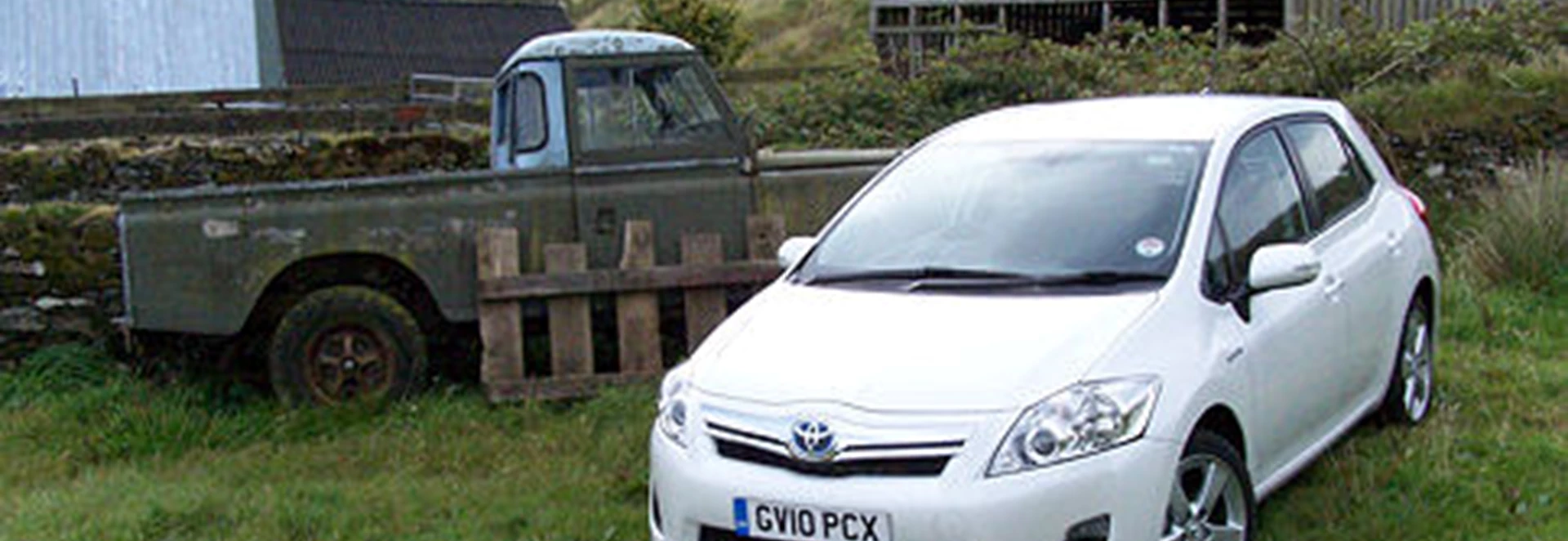
ROAD TEST:

Toyota Auris Hybrid T Spirit review

by David Finlay (7 September 2010)

Engine
1798 cc, 4 cylinders
Power
136 bhp @rpm
Torque
ib/ft @rpm
Transmission
1 speed semi-auto
Fuel/CO2
70.6 mpg / 93 g/km
Acceleration
-
Top speed
-
Price
-
Release date
-


It has been possible to buy a hybrid car in the UK for more than ten years now, and if you did this it's very likely that your supplier was Toyota. Honda is in the game too, of course, with the Insight and the more recent CR-Z, but Toyota leads the sales charts with the Prius and also provides other hybrids through its luxury brand, Lexus. But no previous model was part of the mainstream C segment of the market (the one also containing such popular vehicles as the Ford Focus and Vauxhall Astra), whereas this one is. Sociologically, the arrival of the petrol-electric Auris marks the point where the hybrid finally grew up.

Mechanically, it represents something much less dramatic. This sentence is easier to write than the act described in it must have been to achieve, but essentially what Toyota has done here is bring two existing ideas together, fitting the 1.8-litre petrol engine, electric motor and CVT transmission from the Prius into the body of the Auris.

Toyota Auris Hybrid.The result - properly known as the Auris HSD, for Hybrid Synergy Drive - is by far the most economical and least CO2-emitting car in the range. The entry-level T4 model has an official economy figure of 74.3mpg and a CO2 rating of 89g/km, and although the T Spirit here is hampered slightly by having 17" wheels rather than 15s (as is the T4 when fitted with them) it still manages 70.6mpg and 93g/km, the latter figure making it exempt from annual Vehicle Excise Duty.

Now, before we get too excited about all this, it's worth remembering that official economy figures are not necessarily a reliable guide to how much fuel you will actually use. During this test I managed around 55mpg - more in some driving conditions, less in others, but never far away from that - and to be honest I thought that was pretty good. Some similarly-sized diesels could have done the same on a long and not very challenging run, though they would definitely have lost ground in the city, where the Auris HSD can operate in fully-electric mode for a while if there's enough charge in the battery.

This would be a great time to say that I achieved 55mpg or so without even trying to drive economically, and that I could certainly have got nearer the official figure if I'd tried. But I did try. I accelerated more gently than normal, and braked earlier. I also made much use of the "B" mode on the gear selector, which increases the motor's efficiency as a generator when the car isn't under power, and is a useful alternative to the brake pedal if you want either to reduce speed gradually or to maintain your pace while going downhill.

(Small aside: "B" mode is NOT a substitute for more serious braking, and if some moron tries to blame me for crashing their car because they misunderstood what I have just said, I shall point at them and laugh.)

Toyota Auris Hybrid Interior.If I had been driving normally I probably wouldn't have managed much more than 50mpg, and it would take a lot of concentration to get anywhere near 70. The Auris HSD is certainly economical, but its real advantage is definitely in town. Country-dwellers like me don't get the full benefit.

Even so, there's a lot to be said in the car's favour, not least because it is by far the easiest Auris to drive. Not that other Aurises are especially difficult - it's just that the hybrid leaves you with so little to do, thanks largely to that CVT transmission. The steering is light and very smooth, and although you can sense that the combination of the engine and the electric motor makes the car nose-heavy, Toyota has done a great job of disguising this with clever suspension settings.

The Auris is also noticeably quiet - obviously so when only the electric motor is running, but also when the engine chimes in. It does this quite surreptitiously, and doesn't make much noise unless you're pushing it particularly hard.

My most serious complaint is the presence of the ludicrously large, view-blocking rear pillars, which bedevil every car in the Auris range rather than just this one. And we have to face the fact that no other Auris is remotely as expensive - there's a gap of over £2000 between the most expensive non-hybrid and the cheapest HSD, and at the time of writing the T Spirit costs a hefty £20,700. Even if I lived in the city and could benefit from the considerably reduced running costs, I'd still be hoping for a healthy resale value when it came time to trade in the HSD a few years down the line.

Comments

"I also made much use of the "B" mode on the gear selector,"

This does not help hybrid economy - in fact it will put more wear on your engine and gear selector. It might look like you're getting more charge on gentle braking but on heavier braking it certainly doesn't. Should only be used on long or steep descents. Let the computer decide the mode to be used

I was very specific about "B" mode (which is selected by the driver rather than the computer) not being a substitute for heavy braking. DF

If you want to achieve economical motoring in an HSD car, avoid B mode. In B mode the HSD does regenerate energy, but the engine is also configured to effectively throw energy away (and thus reduce speed). So when you use B mode you waste energy. For instance, when driving down a steep hill and trying to keep speed low, you are better to press the brake pedal or use cruise control. Provided your brake effort does not exceed the regeneration amount on the HSI (Hybrid System Indicator) you won't actually be using the brakes: you will simply be regenerating energy.

Add new comment

Plain text

To prevent automated spam submissions leave this field empty.

Model Search

Manufacturer Search

back to top